


Every winter, orcas and humpback whales follow the herring into the fjords of Northern Norway, and thousands of visitors go out to see them. It’s one of Europe’s great wildlife experiences, but it only stays that way if the boats give the whales room to feed. Here’s what our editors think every traveller should know: what the rules say, which guidelines good operators follow, and how to choose a tour you can feel good about.
Why whale watching needs care
Why the whales come
Norwegian spring-spawning herring spend the winter in the fjords and coastal waters of Northern Norway, and orcas, humpback whales and sometimes fin whales follow them to feed. In recent winters the main feeding areas have been around Skjervøy in Nord-Troms and in fjords in Vest-Finnmark such as the Altafjord, where tours usually run from November to January. Where the herring go changes from year to year, so the whales move too. Read more about whale watching in Alta.
Crowding in recent winters
As whale watching has grown, so has the number of boats. During the 2025–26 season, an established operator and its marine biologists recorded what happened at the whales west of Skjervøy. On average there were 9 to 14 boats at the same whale group, and once 23. Eight in ten boats were within 100 metres of the whales, few switched off their engines, and some went faster than 20 knots in the whale area. The whales changed direction, dived longer and stopped feeding. You can read the findings in the industry’s own report.
Why disturbance matters
The whales come to the fjords to feed. Every time a group is pushed off a herring shoal, it loses food and spends extra energy. Engine noise, sudden changes in speed and boats cutting across their path are a big part of the stress. A good encounter is one where the whales simply carry on with what they were doing, as if the boat wasn’t there.
What about Alta?
Most of the attention has gone to the busiest areas around Skjervøy. But whales also feed in the fjords of Vest-Finnmark, including the Altafjord, and the Directorate of Fisheries’ warning in October 2026 covered this region too. The same law and guidelines apply wherever you go, so everything in this guide is just as relevant in Alta.
What the rules say
- The main rule: Norway’s whale safari regulation from 2019 says whale safaris must be safe, sustainable and considerate, and may not disturb whales in their natural habitat.
- Not just boats: swimming, diving and paddling to see whales also count as whale safari.
- Room for fishing: whale safari boats must stay at least 370 metres (0.2 nautical miles) from fishing vessels and fixed gear, and swimmers, divers and paddlers at least 740 metres.
- Fines: breaking the rules can lead to an infringement fee or a penalty.
The law sets no fixed distance to the whales themselves. That’s where the voluntary guidelines come in. In October 2026 the Minister of Fisheries and Oceans started a review of the whale safari rules, so changes are likely. Read the full regulation on Lovdata (in Norwegian).
The guidelines good operators follow
- Slow down early: under 5 knots within 300 metres, minimum speed from 100 metres and idle speed from 50 metres.
- Approach from the side: slightly from behind and parallel to travelling whales, never head-on or across their path.
- Limit the crowd: no more than 3 boats at a whale group, at most 30 minutes each when others are waiting, and waiting boats more than 500 metres away.
- Let the whales come: if whales approach, the engine goes into neutral, or off, until they’ve passed.
- Leave when needed: stay well away from resting and feeding whales, and move on if they show signs of stress.
- No tricks: no encircling or blocking whales, no luring them with food, sound or light, and a lookout on board as well as the skipper.
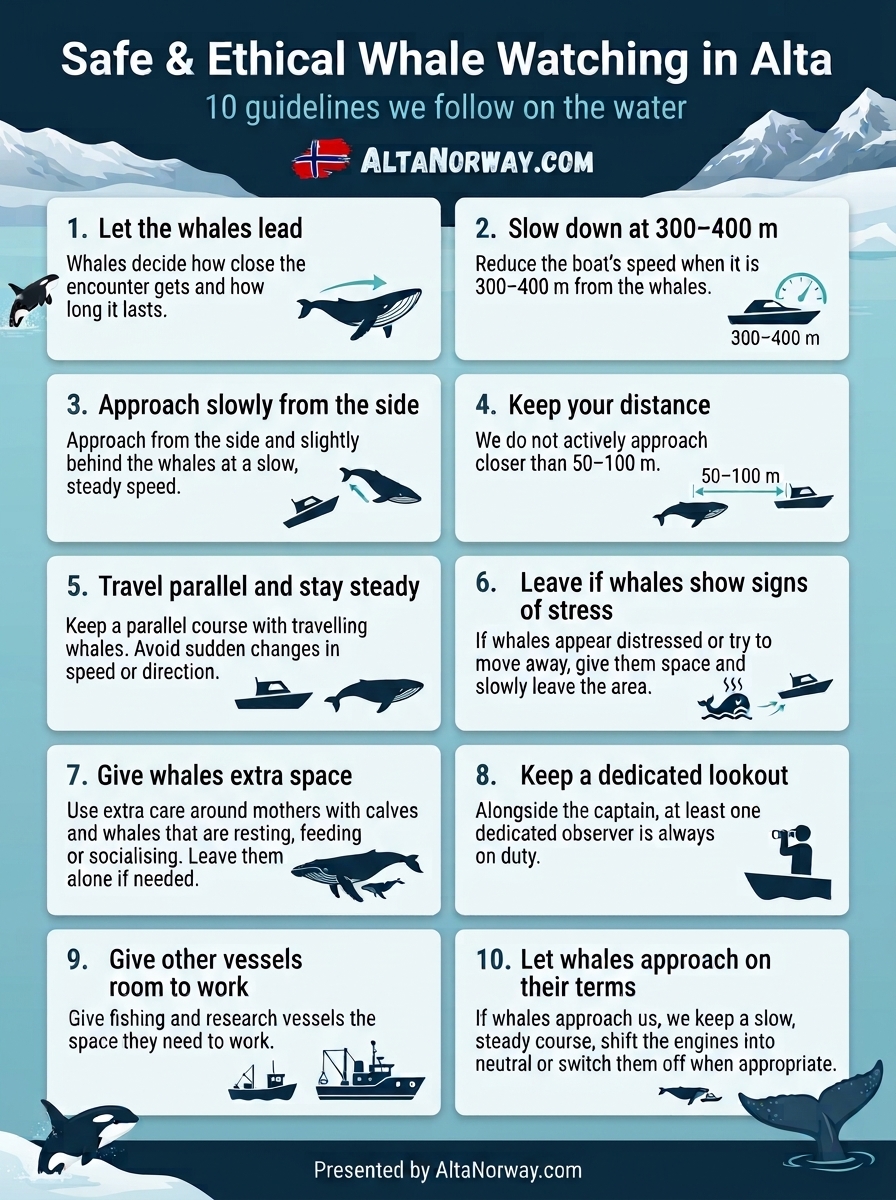
These points come from the whale-watching guidelines for Northern Norway, developed with whale researchers and endorsed by conservation groups such as WDC and OceanCare. Our own 10 guidelines are based on them.
How to choose a responsible whale tour
Ask how they work
Before you book, ask the operator a simple question: which guidelines do you follow? Good operators answer straight away and are happy to explain how they approach the whales. Many already say so on their website.
Look at the boat and the group
Both big boats and small RIBs can be run responsibly. The guidelines ask operators to fill their boats and use larger vessels where they can, because fewer boats mean less pressure on the whales. A small boat isn’t a problem in itself: how it’s driven around the whales is what counts.
Look for a guide, not just a skipper
A lookout and a guide who explains whale behaviour make the trip better and safer. You’ll understand what you’re seeing, and the crew notices early when the whales want to be left alone.
Read reviews and look at photos
Photos of many boats crowding around one whale group say a lot. Reviews that mention the crew switching off the engine and waiting quietly are a good sign.
Be wary of guarantees
Whales are wild animals, and no one can promise a sighting. A tour that guarantees whales may feel under pressure to chase them. A free rebooking if you don’t see any is a fairer offer.
Speak up on board
If your boat races towards the whales or joins a crowd of other boats, it’s fine to say something to the crew. You can also report concerns to the Norwegian Directorate of Fisheries, which supervises whale safaris.
Swimming and snorkelling with orcas
Swimming and snorkelling with orcas is legal in Norway and offered by some operators, also in the Altafjord. Under the regulation it counts as whale safari, so the same rule applies: the whales must not be disturbed. The guidelines for the Tromsø region advise extra care with in-water activities, such as only one boat per whale situation, only a few people in the water at a time, and no swimming near whales that are hunting or feeding, when humpbacks lunging at the surface can be a real risk. If you’d like to try it, choose an operator with an experienced crew, drysuits, a clear safety briefing and first-aid training, and ask how they decide when it’s right to enter the water. In-water activities are part of the current review of the rules, so check what applies when you book.
What’s changing
- May 2026: at a meeting with whale safari operators, researchers and authorities, the Directorate of Fisheries said it receives many concerns about safety and animal welfare, such as boats speeding towards whales and cutting off whale groups, and asked for clearer, measurable rules.
- October 2026: the Directorate warned that whale safaris are disturbing and stressing the whales in the fjords of Nord-Troms and Vest-Finnmark.
- 22 October 2026: the Minister of Fisheries and Oceans announced a review of the whale safari rules and invited the industry to an input meeting.
- Industry proposals: large operators and destination companies have asked for binding rules, including licences with competence requirements, a speed limit in whale areas, a cap on boats per whale group and rules for snorkelling.
- Abroad: countries such as Canada, New Zealand and South Africa already use licences for whale watching.
Our commitment
We only want to send our readers on whale tours we’d happily join ourselves. Together with the local operators we work with, we follow the 10 guidelines in our infographic, and we’ll keep this guide up to date as the new rules take shape. You’ll find the guidelines, with tips for choosing a tour, on our whale watching page.
Frequently asked questions
Yes. A 2019 regulation says whale safaris must not disturb whales in their natural habitat, and sets minimum distances to fishing boats and gear. It doesn’t set a distance to the whales themselves; that comes from voluntary guidelines. The rules have been under review since October 2026.
The law sets no fixed limit. The guidelines used in Northern Norway ask boats to slow below 5 knots within 300 metres, go to minimum speed from 100 metres and idle speed from 50 metres, and let the whales decide whether they come closer.
Yes. It’s legal and some operators offer it, including in the Altafjord. Choose an experienced operator with small groups, drysuits and a clear safety briefing, and check what applies when you book, as the rules are under review.
Usually from November to January, while the herring are in the fjords. The exact timing and place change from year to year, so sightings are never guaranteed.