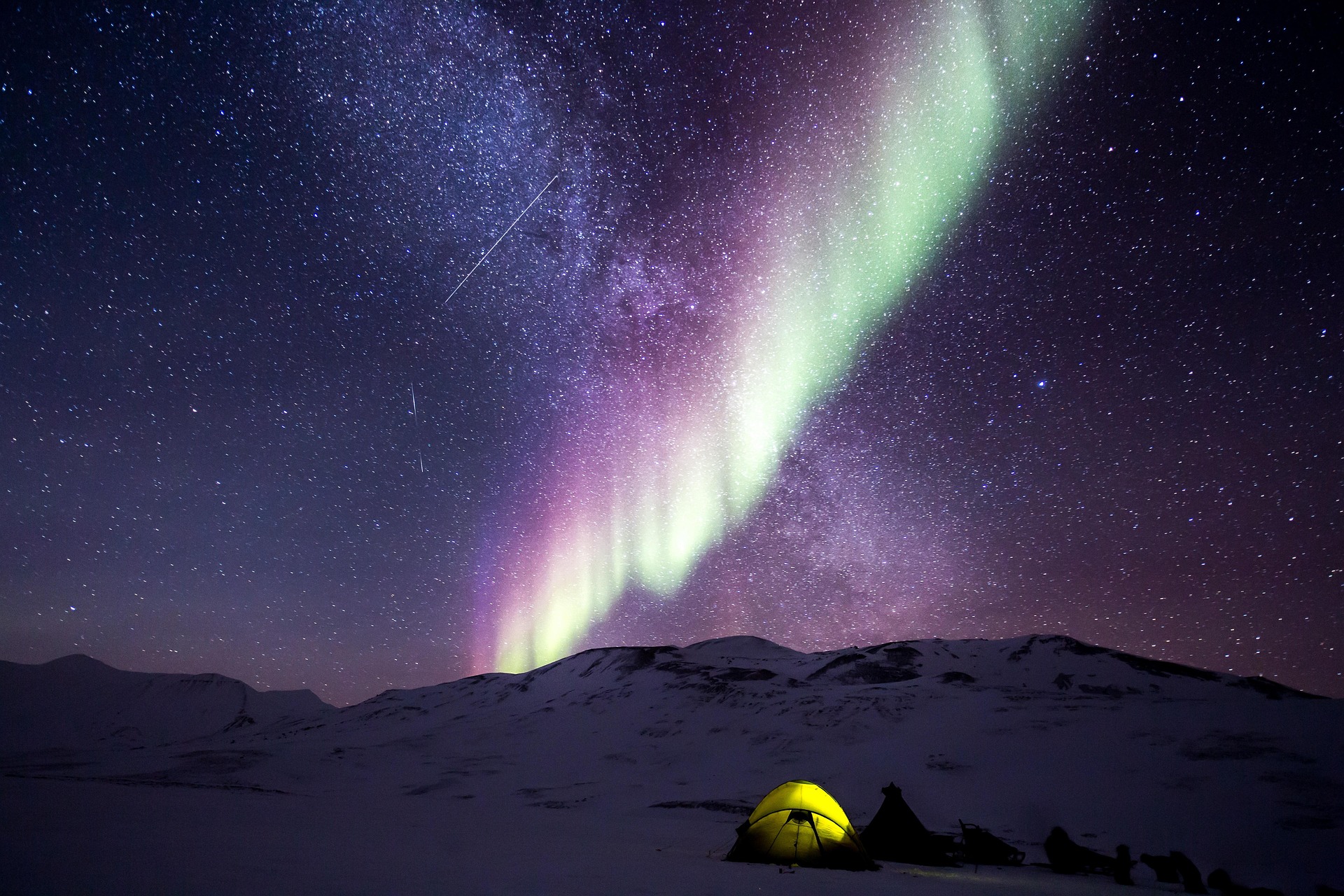

High above Kåfjord, about 20 minutes from Alta, stands the world’s first permanent northern lights observatory. Physicist Kristian Birkeland began his aurora research on the summit of Haldde in 1899, and today the restored stone observatory is a mountain cabin you can hike to, and even sleep in. Here’s our editors’ guide to Haldde: the history, the hike, staying overnight and what to see nearby.
What is the Haldde observatory?
Haldde is the mountain rising above Kåfjord, and you can see it from much of Alta. In 1897 the Norwegian physicist Kristian Birkeland chose its summit as the place to study the northern lights up close, and with money from the Norwegian parliament the first stone observatory was in use in 1899. For almost three decades scientists lived on the mountain all year round, measuring the aurora and the Earth’s magnetic field. Their work helped explain what the northern lights actually are. Today the restored observatory is run as a mountain cabin by the Norwegian Trekking Association (DNT), and the summit is one of the most rewarding hikes in Alta, with views over the Altafjord and far across Finnmark.
A short history of Haldde
- 1899: Kristian Birkeland and his assistants move into the new observatory on the summit for the winter. A second station is set up on nearby Talviktoppen.
- 1910–1915: the state funds a permanent observatory. A new building goes up from 1912, and at its busiest up to 17 people live on the summit.
- 1926: parliament closes the research station, and the work moves to a new observatory in Tromsø, which opens in 1928.
- 1944 to today: German forces burn the buildings during the retreat. Restoration starts in the 1980s, and since 2016 the old observatory has been a DNT cabin. You can read more on the Alta Museum website.
Hiking to Haldde
The route follows a marked footpath along an old cart track all the way to the summit. It isn’t technical, but it’s a long, steady climb, and the last part is steeper and rockier. With a reasonable level of fitness it makes a great full-day hike. Check the full route on DNT’s ut.no before you go.
- Trailhead: the old cart road leaves the E6 near Kåfjord bridge, about 400 m north of Kåfjord Church. Parking is limited, so arrive early.
- Distance: about 9 km each way.
- Climb: roughly 900 m from sea level to the summit.
- Time: about 3 hours up at a normal pace. Plan on at least 6 hours for the round trip, plus time at the top.
- Water: there’s no drinking water on the summit. The last stream is about 2 km before the final climb, so fill up there.
- Weather: the summit is exposed and almost always windy. Bring a windproof jacket, a warm layer, a hat and gloves, even in July.
- Midnight sun: from mid-May to late July the sun never sets, so you can hike in the evening and watch the light over the fjord at midnight.
Staying overnight in the observatory
The DNT cabin
The old stone observatory is now a self-service DNT cabin, open all year. It has six beds in bunks plus a few extra mattresses, with duvets and pillows; bring your own sleeping bag liner. There’s a wood stove, 12-volt lighting, a gas cooker and a kitchen with pots and dishes, and the toilet is in a small service building next door. The best spot is the glass dome on top of the old observatory tower, with views in every direction. You can even hang a hammock up there. Bring all your food and water, and carry your rubbish back down.
Key and booking
The cabin is locked with the standard DNT key, and at least one person in your group must be a DNT member. Members can order the key from the DNT shop or buy it at Canyon Jakt og Fiske in Alta by showing their membership card. Booking ahead on ut.no is recommended. Without a key, you can still shelter in the emergency room in the first building you reach.
Prices
A night costs NOK 250 for DNT members and NOK 500 for non-members. Young people aged 13 to 25 pay NOK 125 (members) or NOK 250, children aged 4 to 12 stay free with membership or pay NOK 125, and under-4s are free. A day visit inside the cabin costs NOK 50. If you haven’t paid online, pay by Vipps or bank transfer as explained on the cabin page.
Haldde in winter and the northern lights
The cabin stays open in winter, but the climb becomes a serious ski or crampon ascent through avalanche terrain, with no prepared ski track. It’s only for experienced winter hikers with the right gear, who check the avalanche warning on Varsom first. For most visitors, the easiest way to see the lights Birkeland studied is a guided evening tour from Alta, such as this small-group northern lights tour with a campfire. If you’d like a winter walk in the mountains by day, try the guided snowshoe hike to a frozen waterfall. Read more in our northern lights guide.
Make a day of it in Kåfjord
- Kåfjord Church: a wooden church from 1837, built for the copper-mining community and just a short walk from the trailhead.
- Tirpitz Museum: the German battleship Tirpitz lay hidden in Kåfjord in 1943–44. The Tirpitz Museum tells her story with a large collection of photos and objects.
- The copper works: from 1826 Kåfjord was home to one of Norway’s biggest mines, and you can still see traces of it in the landscape. The English mine managers also helped start the northern lights research in Alta.
- Sakkobadne: fit hikers can add this shorter heritage trail, which also starts in Kåfjord and passes war ruins and aircraft wreckage.
Back in Alta, find more ideas in our guide to sightseeing in Alta, our 3-, 5- and 7-day plans and our list of places to stay.
Frequently asked questions
Yes. The summit is free to hike to at any time. To go inside the DNT cabin you need a DNT key, and a day visit costs NOK 50. Without a key you can shelter in the emergency room of the first building.
About 9 km each way with roughly 900 m of climbing. Most people need around 3 hours up and at least 6 hours for the round trip.
Yes. The old observatory is a self-service DNT cabin with six beds, open all year. At least one person in your group must be a DNT member with a DNT key. A night costs NOK 250 for members and NOK 500 for non-members.
No. You can only reach the summit on foot in summer, or on skis or with crampons in winter. You can drive to the trailhead in Kåfjord, about 20 minutes from Alta.
Yes, on clear nights in the dark season, from late September to early April. But winter access is demanding and only for experienced mountain hikers, so most visitors see the lights on a guided tour from Alta instead.
Alta lies under the northern lights oval, where the aurora is common, and a high summit gave the scientists an open view of the whole sky. The area already had a long tradition of aurora research: scientists had been observing the northern lights in Kåfjord and Bossekop since the 1830s.